Model registry
Maintain a governed inventory for AI models and use-case context with lifecycle state, ownership, risk posture, and supporting evidence.
- • Structured model records and intake depth
- • Lifecycle visibility
AI governance platform
SentinelAI connects model registration, runtime AI systems, datasets, prompt and RAG governance, evaluation suites, release records, governance cases, telemetry connectors, semantic operations, vendor review, compliance workflows, monitoring observations, and reporting so AI oversight can run as one platform instead of a set of disconnected reviews.
Platform overview
Use the overview branches for context, then move into the visible product proof and deeper workflow detail below. This page is the clearest product overview for buyers comparing AI governance platforms.
SentinelAI is built for organizations that need more than a point-in-time model inventory.
A cross-functional operating layer for shared governance execution.
0+
Governed capabilities across the AI lifecycle
0+
Model, data, and cloud integrations
0
Frameworks: EU AI Act, NIST, ISO 42001, ISO 27001, SOC 2, GDPR
100%
Tamper-evident, hash-chained audit evidence
End-to-end operating model
These stages reflect how SentinelAI connects the runtime, prompt, retrieval, release, telemetry, and reporting product areas described across the platform today.
Start with a governed inventory of use cases, models, AI systems, prompts, retrieval sources, datasets, vendors, owners, and intended use so later reviews are grounded in shared records.
Use taxonomy and ontology administration to keep classifications, relationship rules, and graph traversal consistent across governance, risk, security, legal, and ML teams.
Route obligations, evaluations, release approvals, cases, evidence requests, and remediation actions to the right stakeholders across governance, risk, security, legal, and ML teams.
Connect telemetry observations, vendor refreshes, dataset changes, prompt updates, and operating changes back to the same governance records.
Summarize posture for executives, auditors, customers, and governance councils without losing the path back to source evidence.
Where it sits
Scroll to see how SentinelAI sits between the systems you already run and the auditors, regulators, and executives who need proof.
Where models, data, and agents already live
The operating layer that sits across the stack
Shipped with oversight, not blocked by it
Proof they can independently verify
The platform, end to end
Each step of the operating model maps to a real workspace in SentinelAI — from inventory and data governance through use-case intake and evidence-backed framework review.
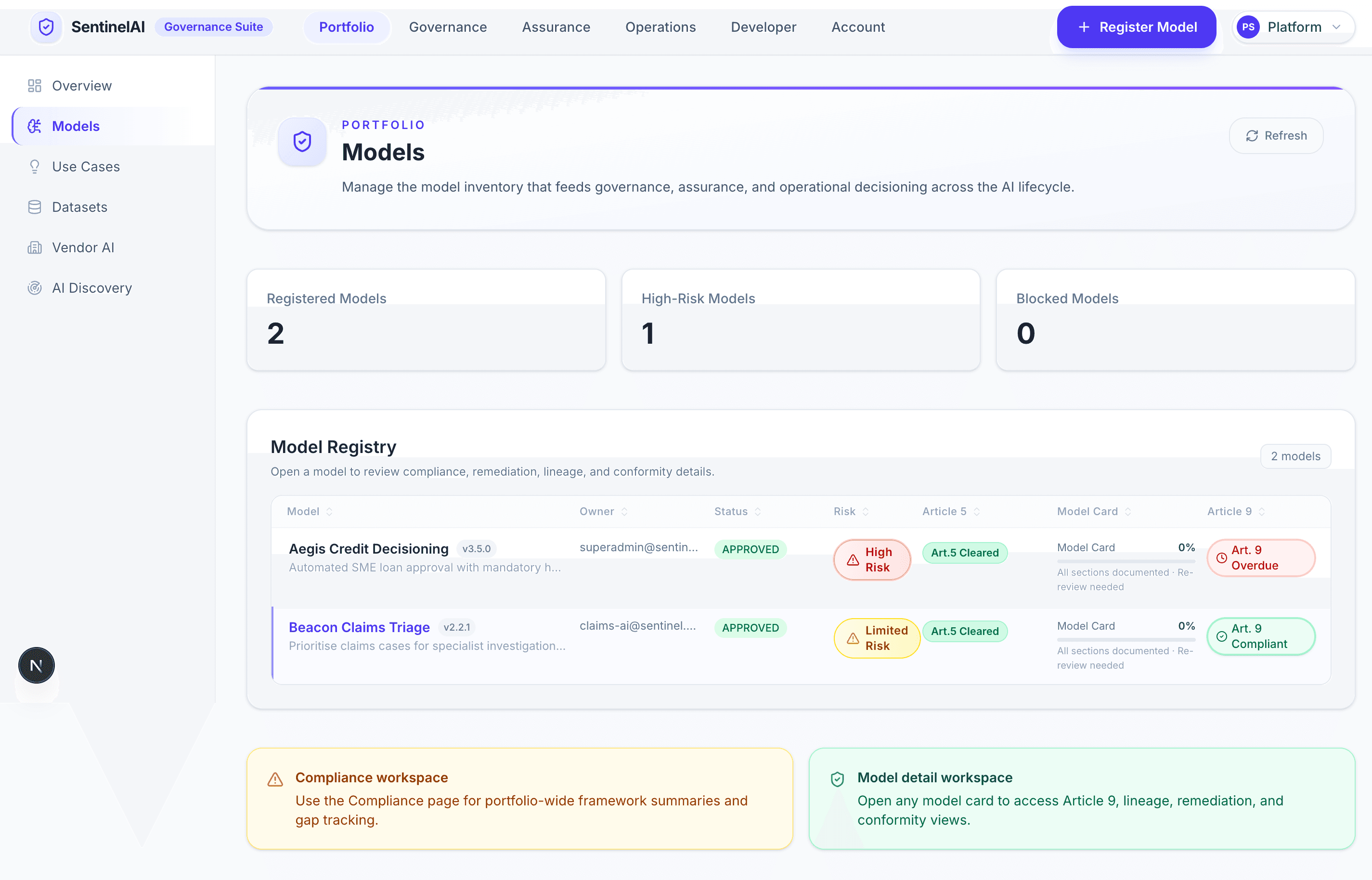
Inventory of record
Start from a single system of record for models, runtime AI systems, and the use cases behind them — with intended use, owners, lifecycle status, and release references kept together so every later review is grounded in shared context.
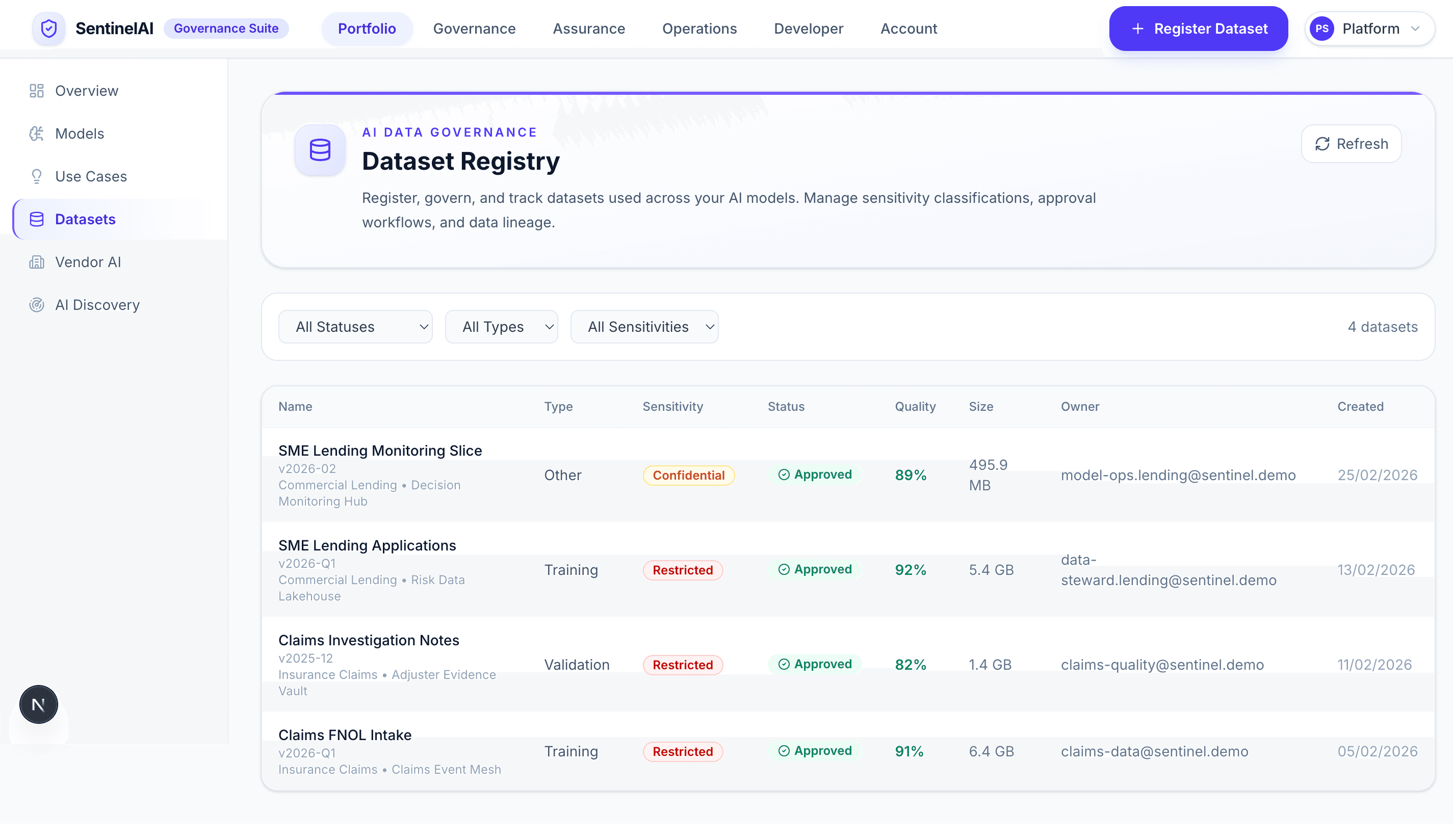
Data governance
Govern datasets and RAG sources with quality signals, taxonomy-backed classification, lineage, and approval state — so the data behind every AI system stays explainable and audit-ready rather than scattered across spreadsheets.
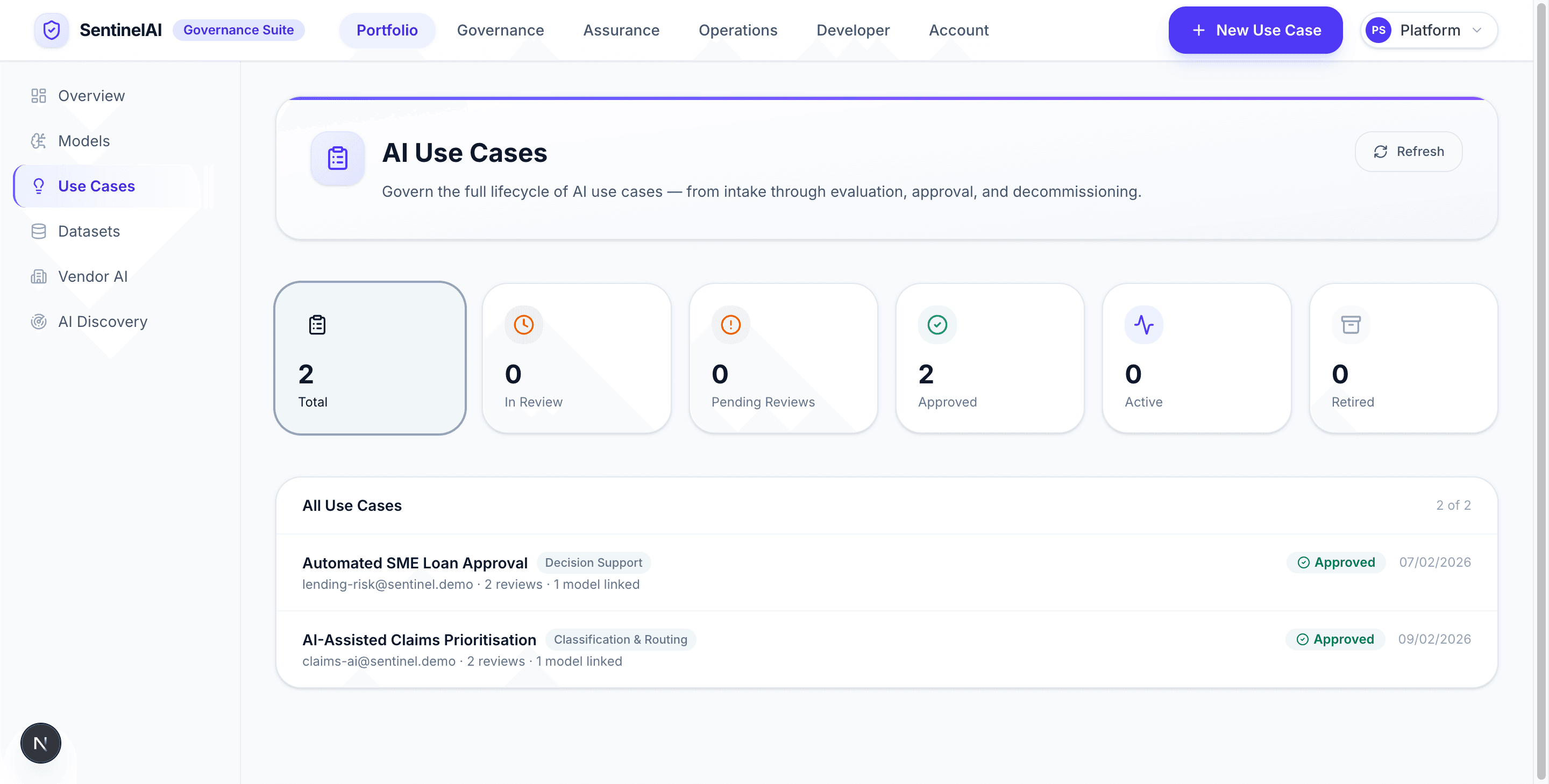
Use-case intake
Capture the business objective, application context, accountable owners, and review triggers in structured intake — so downstream evaluation, controls, and reporting all trace back to why an AI system was built.
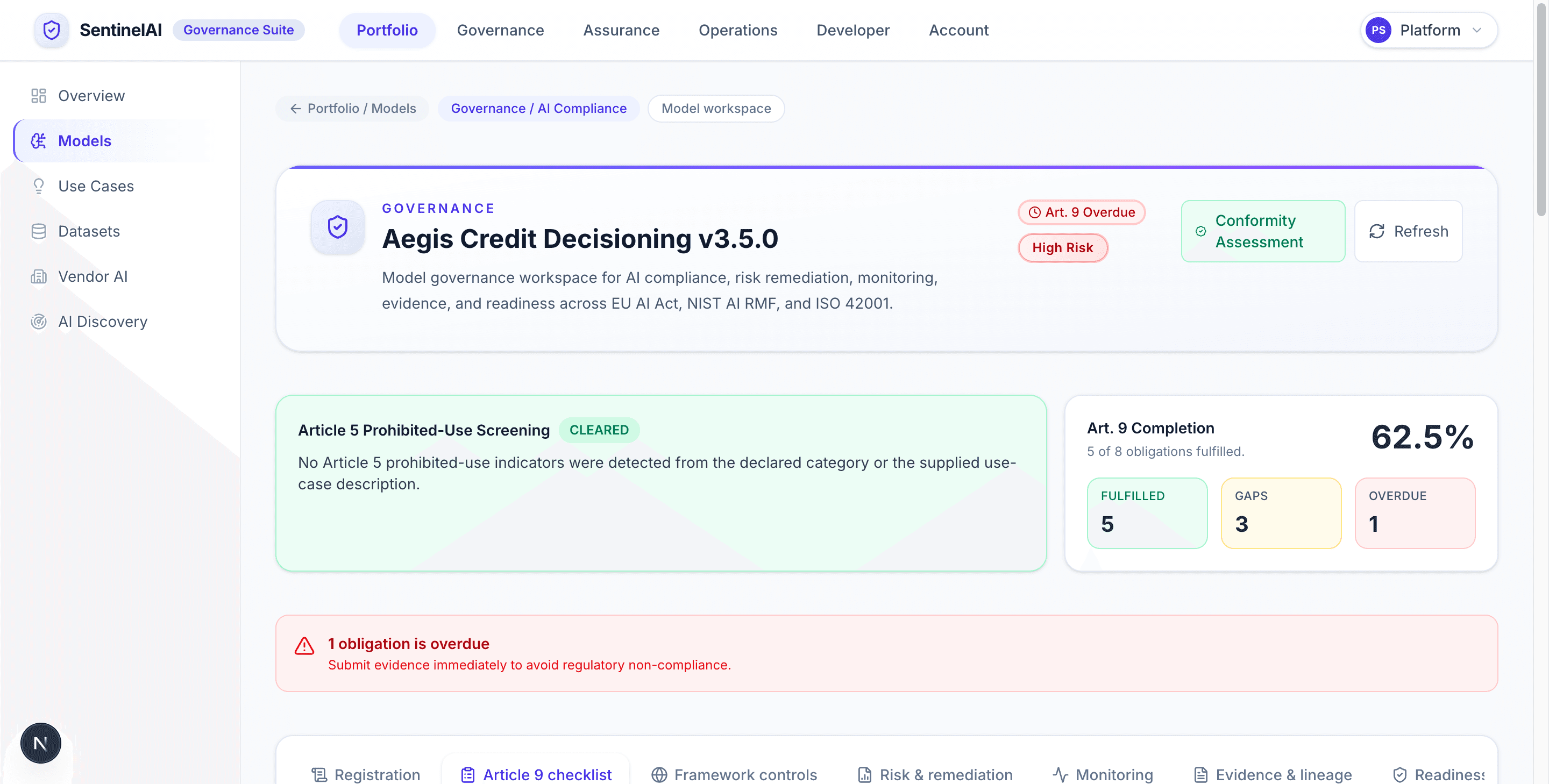
Review and evidence
Map obligations from the EU AI Act, NIST AI RMF, and ISO 42001 to concrete evidence and owners at the model level — with checklist status, evidence actions, and governance tabs in the same workspace the review team already lives in.
Platform objects
SentinelAI brings together the core runtime, prompt, retrieval, workflow, and evidence objects governance teams need to understand AI use end to end.
Register models and runtime AI systems with intended use, owners, lifecycle status, linked use-case context, release references, and supporting governance history.
Capture the business objective, application context, accountable owners, and review triggers that explain why an AI system exists before downstream governance work begins.
Track datasets and governed retrieval sources with quality signals, taxonomy-backed classification, lineage, ingestion posture, and approval state.
Govern versioned prompts, retrieval configuration, linked RAG sources, and the AI systems they influence from dedicated operational records.
Run semantic governance in Operations with shared taxonomy terms, ontology entity and relationship administration, and graph-backed traversal across connected records.
Keep external providers, due-diligence artifacts, review notes, and procurement follow-up connected to the same governance program.
Map internal policies and external frameworks such as the EU AI Act, NIST AI RMF, and ISO 42001 to concrete evidence and owners.
Tie prompt regression evidence, baselines, release approvals, rollback references, and dependency invalidation into one governed readiness loop.
Coordinate alerts, findings, release exceptions, remediation tasks, evidence posture, and SLA deadlines in a shared case-management layer.
Bring drift, fairness, evaluation, and operational observations into governance reviews while retaining an audit-ready trail of what changed.
Turn source records into executive reporting, stakeholder-ready evidence packs, and governance certificate workflows.
Impact radius
Because objects stay connected, you can follow a dataset through the models and decisions it feeds — and see the compliance risk each step inherits. Hover a node to trace downstream impact.
Data lineage
Hover a node to trace impactIllustrative. In product, lineage and impact-radius run across your real datasets, models, and controls.
Product in practice
These product views show how SentinelAI turns the operating model into a working interface across portfolio oversight, model review, datasets, discovery, and related governance workflows.
Product proof
A portfolio-level command view with lifecycle metrics, risk heat mapping, compliance trend, and framework coverage.
Product proof
Model-level oversight with Article 9 checklist status, evidence actions, and governance tabs across the full review workflow.
Product proof
Dataset inventory with sensitivity, approval status, quality signals, ownership, and governance-ready filtering.
Product proof
Discovery and third-party AI views that help teams surface assets, track connectors, and govern external providers inside the same operating model.
Workflow design
Use these branches to understand why the workflow is structured this way and what teams gain from a shared operating layer.
Structure governance work around accountable teams and durable records.
Instead of tracking AI systems, use cases, datasets, obligations, and reviews in separate tools, teams work from linked records that stay current over time.
Compliance, risk, procurement, security, data science, and business owners can each see the work and decisions that belong to them.
Approvals, observations, remediation work, and reporting remain connected to the underlying systems they describe.
Structured intake, shared taxonomy, and graph-backed relationship views reduce the friction that often slows AI application development and value realization.
Explore the platform in more detail
The platform page provides the full narrative; the links below route visitors into the specific product areas and supporting content behind it.
Maintain a governed inventory for AI models and use-case context with lifecycle state, ownership, risk posture, and supporting evidence.
Track governed runtime systems that combine models, approved use cases, datasets, release state, and readiness into one operational record.
Govern versioned prompts, retrieval settings, linked AI systems, and evaluation posture from a dedicated prompt operations record.
Register governed retrieval sources with ingestion status, version history, citation context, and AI-system linkage.
Operationalize evidence collection, control tracking, remediation, and framework mapping across AI systems.
Bring datasets, lineage, approvals, taxonomy-backed controls, catalog integrations, and quality gates into the AI governance workflow.
Operate taxonomy, ontology, relationship, and graph-backed governance workflows across models, use cases, datasets, controls, and evidence.
Define governed prompt evaluation suites with baselines, regression thresholds, run evidence, and release-blocking posture.
Manage AI-system release records with approval state, rollback references, dependency snapshots, and invalidation handling.
Coordinate alerts, findings, remediation, evidence posture, SLA deadlines, and closure outcomes in one shared case workspace.
Manage telemetry providers, ingest cadence, connector health, and manual signal pulls from a first-class governance control plane.
Detect risks, duplicate AI initiatives, overlap, and rationalization opportunities across governed records with explainable, human-reviewed analysis.
Bring live assurance signals, telemetry connector management, trigger rules, and evidence-ready monitoring context into AI governance workflows.
Prepare executive reporting, audit-ready evidence views, and governance certificate workflows without overstating outcomes.
Register third-party AI vendors, structure due diligence, and connect external AI dependencies to internal governance records.
Govern autonomous and multi-agent AI with declared tool permissions, autonomy levels, memory scope, and full chain-of-custody across agent executions.
Monitor live LLM outputs for toxicity, PII leakage, prompt injection, and hallucination against per-model thresholds, using privacy-preserving request hashes.
Find unsanctioned and ungoverned AI across the business through detection sources and CSV import, risk-score candidates, and register them into governed inventory.
Estimate per-model CO2e and energy use from training compute, set monthly carbon budgets per tenant, and roll sustainability up to a portfolio view.
Track changing AI regulation with auto-ingested updates matched to a tenant regulatory profile, impact assessment, and a radar timeline that routes changes to owners.
Track vendor contracts and clauses, score clauses for missing data-protection and SLA terms, alert on 90-day expiries, and pair with a versioned due-diligence questionnaire builder.
Generate a content-hashed AI Bill of Materials capturing model, dataset, and framework provenance, flag license conflicts, and export CycloneDX, SPDX, and PDF.
Answer compliance questions in natural language grounded in a regulatory knowledge base, with proactive nudges and session history across EU AI Act, NIST AI RMF, ISO 42001, and GDPR.
Related explainer
Follow the operating model step by step, from AI system intake through review, monitoring, and executive reporting.
Related docs
Review the reusable docs experience and supporting content patterns that will expand into deeper platform guides and references.
Next step
Use this page to align stakeholders on the operating model, then move into a demo, docs review, or product trial based on your team’s stage.